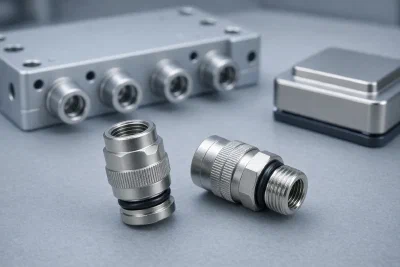
A leak-free connector for data center liquid cooling is a small component, but it concentrates all the problems of a liquid circuit: corrosion, metal release into the fluid, wear at every mating cycle, O-ring sealing, and threads and internal passages that are hard to reach. At Micron we routinely process quick couplings and quick disconnects in high-phosphorus electroless nickel-plated brass for this sector, and this is our starting point for discussing surface treatments for liquid cooling: connectors, copper cold plates, aluminum manifolds and heat sinks.
The context explains why the topic has become urgent. According to a Bernstein report, a single NVIDIA GB200 NVL72 cabinet houses 108 cold plates, and the cold plate market, currently worth 2–3 billion dollars, will reach 6–7 billion by 2030 in the base case scenario. More wetted components mean more surfaces to protect.
Why a liquid cooling circuit degrades
The reliability requirements for these circuits are now defined mainly by the OCP (Open Compute Project), the international consortium that brings together the main hyperscale operators and hardware manufacturers to define open standards for data centers, including liquid cooling systems. Its specifications focus on three main critical issues.
Galvanic couples between copper, brass and aluminum
Copper, brass and aluminum coexist in cooling circuits. In a conductive fluid such as water-glycol, two metals with different potentials that are electrically connected form a galvanic cell, and the less noble one corrodes. The OCP specification on fluids for cold plates states this explicitly: the combination of aluminum and copper is known to cause galvanic corrosion problems.
Brass dezincification and zinc in the fluid
Brass is a copper-zinc alloy. In water and water-glycol, zinc can dissolve selectively and leave behind porous, mechanically weak copper: this is dezincification. The OCP guidelines for propylene glycol-based fluids prefer brasses with less than 15% zinc and, above this threshold, require verifying their resistance with the specific test defined in ISO 6509.
Particles in microchannels
Cold plates operate with narrow microchannels. OCP recommends bypass filtration below 5 µm precisely to prevent particulate from becoming trapped in the channels. The OCP test specification for direct-to-chip cold plates provides for an ultrasonic bath wash with allowable particulate below 50 µm and fluid compatibility tests according to modified ASTM D8040, followed by ICP analysis of the released ions. Oxides, machining residues and coating fragments are exactly what these tests detect.
Leak-free connectors in high-phosphorus electroless nickel-plated brass: NIPLATE® 500
Electroless nickel-plated brass is a well-established industrial solution for fittings and connectors in contact with fluids, and leak-free liquid cooling connectors are an ideal application. Our choice is NIPLATE® 500
, a high-phosphorus (P 10–13%) electroless nickel coating, compliant with ISO 4527 NiP(11) and ASTM B733 Type V.
Why high phosphorus
The phosphorus content determines the microstructure of the Ni-P alloy and, with it, its chemical and mechanical properties (NIPLATE® coatings
). For a connector immersed in the fluid, high phosphorus offers three advantages:
- amorphous structure: thanks to the high phosphorus content the alloy is amorphous, which gives it high chemical resistance to many aggressive agents. Among electroless nickel coatings, high phosphorus has the best chemical and corrosion resistance;
- very low porosity even at low thicknesses: under typical industrial conditions, above 30 µm the coating can be considered free of through-porosity (corrosion resistance
);
- stability in water and glycol: in the chemical resistance
tables, high-phosphorus Ni-P is in class A, with a layer corrosion rate below 2.5 µm/year, in demineralized water up to 80–82 °C, in distilled water and in ethylene glycol at 20 °C. This is the starting point for qualification on the part with the design fluid.
A continuous barrier between brass and fluid
Electroless nickel protects through a barrier effect: a continuous Ni-P layer isolates the brass from the fluid, so there is no direct contact, no dezincification and no zinc in solution. On copper alloys the behavior is particularly favorable: coating and base material have a very similar reduction potential, so no galvanic couple forms and any porosity has very little influence on the corrosion of the part (electroless nickel thickness for corrosion resistance
). On brass, with 20 µm of NIPLATE® 500, the part withstands over 1000 hours in neutral salt spray (ISO 9227) with a protection rating Rp 9 (ISO 10289).
Hardness and wear during mating cycles
A quick disconnect operates through mating and unmating cycles. After the dehydrogenation heat treatment alone (160–180 °C x 4 h), NIPLATE® 500 already reaches a hardness of 550±50 HV, comparable to that of a hardened steel, with a Taber wear loss (ASTM B733 X1, CS10 wheels, 1 kg) of 20±2 mg / 1000 cycles. In this condition it retains the amorphous structure and maximum chemical resistance to the fluid, while offering a hard, uniform surface that slides consistently against the seals and keeps the protective layer intact in the contact areas.
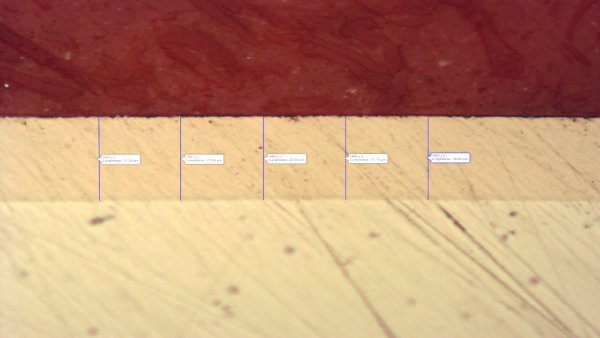
Electroless nickel is deposited by autocatalytic reduction, without external current: there is none of the edge effect of electroplated deposits, which concentrate metal on edges and ridges and leave too little in holes and cavities. The thickness is uniform on external and internal surfaces, from 3 to 50 µm for NIPLATE® 500, with a tolerance of ±10% of the nominal value (minimum ±2 µm). For a connector this means O-ring seats that remain within tolerance (dimensional tolerances and electroplating treatments
) and threads and internal passages protected like the external surfaces.
Nickel-plated brass and OCP guidelines. The OCP guidelines on propylene glycol-based fluids are evolving and currently indicate stainless steel for quick connects. Other OCP documents already record industrial practice: the white paper Hose and Manual Couplings – Best Practices states that couplings for thermal control are typically made of stainless steel, nickel-plated or chrome-plated brass, and hard-anodized aluminum; the rack manifold white paper (v3) lists nickel-plated brass as compatible with a commercial PG25 fluid.
For cold plates, heat exchangers and copper components, electroless nickel remains the standard choice. The Ni-P alloy applied as a thin, uniform layer protects copper from oxidation, corrosion and ion release into the fluid, with limited impact on heat transfer and electrical contact.
On copper alloys, modest thicknesses are sufficient: depending on the operating condition, from 5±2 µm (dry indoor environment) to 20±2 µm (highly aggressive environment). NIPLATE® LINK
, developed for copper electrical components, has P 8–13%, a typical thickness of 5–15 µm ±2 µm, and withstands over 1000 hours in neutral salt spray (ISO 9227) on copper with 5 µm, with a corroded surface area of less than 1%. It protects the copper of the cooling circuit and prevents the release of salts and ions into the fluid.
Manifolds and aluminum parts: low-roughness OX-W hard anodizing
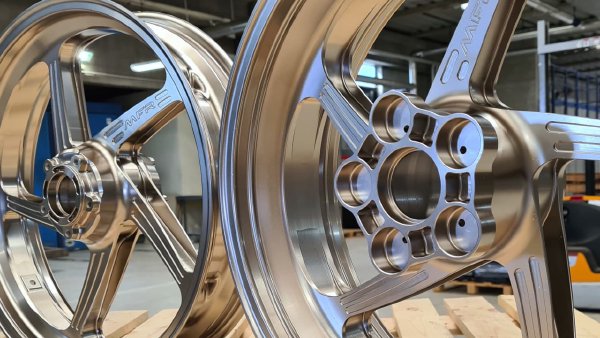
For manifolds, plates and aluminum components, the solution is Durox’s OX-W hard anodizing
. Hard anodizing transforms the surface into compact aluminum oxide, providing corrosion and wear resistance, hardness and dielectric insulation (what hard anodizing is
). OX-W complies with MIL-PRF-8625 Type III, ISO 10074 and UNI 7796. Compared with traditional hard anodizing it has lower roughness, higher corrosion resistance and a lighter color.
Isolating aluminum from copper
In a mixed circuit, the anodic layer electrically interrupts the galvanic couple between aluminum and copper, with a continuous layer of uniform thickness on the external surfaces.
Low roughness: particles and seals
Hard anodizing tends to slightly increase roughness; OX-W keeps it under control. With specific alloys and defined operating parameters, the final roughness remains below 0.5 µm Ra. In a liquid circuit, a smoother surface results in:
- fewer particles, because peaks and asperities are the first points to detach through erosion or during assembly, and they trap machining residues;
- reliable sealing on O-ring and gasket seats.
OX-W is optimized to provide high wear resistance with a limited thickness and low roughness. The thickness grows 50% outward and 50% inward: the dimensional increase per surface is half the treatment thickness. The best performance is obtained on 6000 series alloys.
Aluminum and copper heat sinks
The same criteria apply to heat sinks for power electronics and data centers, whether air- or liquid-cooled.
Aluminum heat sinks: OX-W. Hard anodizing protects against corrosion and wear and electrically insulates the heat sink, a valuable property near live parts. The contact bases with the power module can be masked so as not to introduce thermal resistance.
Copper or aluminum heat sinks: NIPLATE®. Electroless nickel protects copper and aluminum from oxidation and corrosion and uniformly covers fins, channels and complex geometries, where an electroplated deposit would leave uncovered areas. NIPLATE® coatings are solderable and brazable. If the primary function is soldering, hardening heat treatments should be avoided because they form a surface oxide that reduces wettability; for solderability that is stable over time, the reference is NIPLATE® LINK.
Designing the part for treatment
The surface treatment is part of the design, not an afterthought:
- dimensions: with electroless nickel, the part is machined allowing for the added material (tolerance ±10%, minimum ±2 µm): 10 µm of coating reduces the diameter of a hole by 20 µm and, on metric threads, the diametral deviation is equal to 4 times the thickness; with hard anodizing, a 50% growth per surface is taken into account. The pre-treatment dimensional tolerance calculator
helps define the dimensions;
- fluid compatibility: the OCP guidelines require verifying fluid compatibility with all wetted materials at the maximum operating temperature. The coating is a wetted material and must be qualified on the treated part, with the design fluid, together with the customer.
Laboratory testing
The Micron Coatings Group laboratory performs routine checks, treatment validation and failure analysis (quality and technical support
):
| Parameter | Method |
|---|
| Coating thickness | Microscope, ISO 1463; eddy currents, ISO 2360 |
| Phosphorus content of electroless nickel | EDS spectroscopy |
| Electroless nickel porosity | Ferroxyl test, ASTM B733 |
| Adhesion | ISO 2819 |
| Vickers microhardness | ISO 4516 |
| Surface roughness | ISO 4288 |
| Salt spray corrosion resistance | ISO 9227, ISO 10289, ASTM B117 |
| Wear resistance, Taber Abraser | ISO 10074 B.3 |
| Morphology and composition | SEM with EDS probe |
Frequently asked questions
Why high-phosphorus electroless nickel-plated brass for leak-free connectors?
NIPLATE® 500 is a high-phosphorus electroless nickel coating (P 10–13%): its amorphous structure gives it the best chemical and corrosion resistance among electroless nickel coatings, with very low porosity even at low thicknesses. The continuous layer isolates the brass from the fluid and prevents dezincification and zinc release; on brass, at 20 µm, it withstands over 1000 hours in neutral salt spray. It uniformly covers threads, seats and internal holes, keeping O-ring seats within tolerance, and already in the dehydrogenated state it reaches 550 HV, a hardness comparable to that of a hardened steel, to withstand mating cycles.
Why electroless nickel and not electroplated nickel?
Electroless nickel is deposited without external current and has no edge effect: the thickness is uniform on external and internal surfaces, with a ±10% tolerance (minimum ±2 µm). An electroplated deposit concentrates on edges and ridges and leaves less metal in holes and cavities.
Which treatment for cold plates and manifolds?
NIPLATE® on copper and copper alloy parts, OX-W hard anodizing on aluminum parts. The anodic layer electrically isolates aluminum from copper, and the low roughness limits particles and sealing problems.
Which treatment for aluminum and copper heat sinks?
OX-W hard anodizing on aluminum, for corrosion resistance, wear resistance and electrical insulation, with masking of the contact bases. NIPLATE® on copper or aluminum, for corrosion protection, uniform fin coverage and solderability.
Does electroless nickel impair heat transfer in copper?
The Ni-P alloy has lower thermal conductivity than copper, which is why a thin, uniform layer is applied on copper, starting from 5 µm: it protects the copper with limited impact on heat transfer and electrical contact.
Ing. Giacomo Bordiga
Quality Manager & Materials Engineer
Materials Engineer with over 15 years of experience in metal surface treatments. Specialized in electroless nickel plating, anodizing and quality management systems ISO 9001 and IATF 16949.