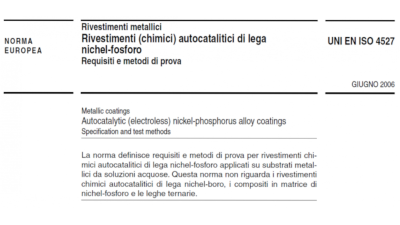
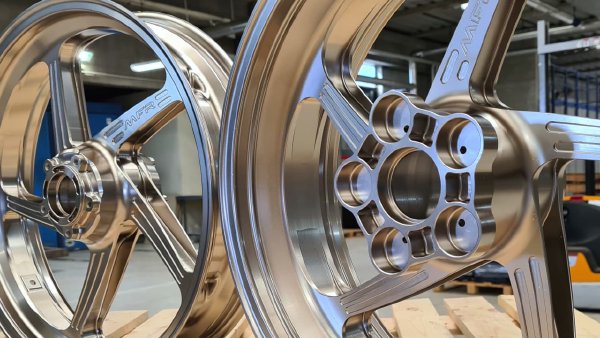
ISO 4527, “Autocatalytic (electroless) nickel-phosphorus alloy coatings,” is the international standard for electroless nickel coatings. The standard defines a standardized treatment designation, together with the specifications and main characteristics of the treatment to be applied to the parts.
The use of this standard allows the designer and the customer to uniquely specify the characteristics of the treatment. This makes it possible to minimize misunderstandings and errors that may occur in the case of unclear treatment specifications.
However, the designation defined by ISO 4527 is not complete and it is necessary to integrate it to better indicate some characteristics, such as the treatment thickness or hardness required.
Designation according to ISO 4527
The designation, to be entered in the title block of the technical drawing, is structured as follows:
Autocatalytic nickel coating ISO 4527 - a<b>/NiP(c)d[e(f)g]
The designation consists of a first part, a<b>/, which refers to the base material, where:
- a: The symbol of the main element in the base-material alloy; for example, Fe for steels;
- b: The alloy designation; for example, S235JR;
The second part NiP(c)d refers to the deposited electroless nickel layer, where:
- c: The phosphorus content of the coating, indicated as a whole number. By convention, the following values are used:
- NiP(7), for medium-phosphorus electroless nickel, Niplate 600;
- NiP(11), for high phosphorus electroless nickel, Niplate 500;
- d: The minimum coating thickness in µm, indicated as a number;
The third part [e(f)g] refers to heat treatment following electroless nickel plating, where:
- e: The type of heat treatment, indicated by a symbol:
- ER indicates embrittlement relief (Embrittlement Relief)
- HT indicates hardening (Heat Treatment)
- f: The heat-treatment temperature in degrees Celsius, expressed as a number;
- g: The treatment duration in hours, expressed as a number.
The heat treatments usually carried out are the following:
- Embrittlement relief: 180°C x 4h - [ER(180)4]
- Hardening: 260°C x 8h - [HT(260)8]
- Hardening: 340°C x 4h - [HT(340)4]
Designation example
A medium phosphorus electroless nickel plating, Niplate 600, with a thickness of 20-25µm with hardening treatment at 340°C for 4 hours to obtain a hardness of 1000±50HV, steel 18NiCrMo5 is designated as follows:
Autocatalytic nickel coating ISO 4527 - Fe<18NiCrMo5>/NiP(7)20[HT(340)4]
Please note that two important pieces of information are missing. The designation specified by the standard is incomplete and should be supplemented with the following information:
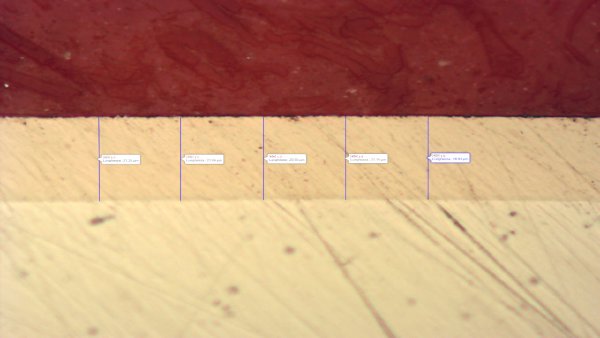
- The maximum thickness is not specified. The designation gives only the minimum thickness of 20µm.
- The indication of the coating hardness is missing.
It is recommended to complete the designation with the missing information as below:
Autocatalytic nickel coating ISO 4527 - Fe<18NiCrMo5>/NiP(7)20[HT(340)4] - Thickness: 20-25 µm - Hardness: 1000±50 HV
Ing. Giacomo Bordiga
Quality Manager & Materials Engineer
Materials Engineer with over 15 years of experience in metal surface treatments. Specialized in electroless nickel plating, anodizing and quality management systems ISO 9001 and IATF 16949.