
OX-A
Clear anodizing
OX-A is a clear aluminium anodizing treatment in compliance with MIL-PRF-8625 Type II and ISO 7599.
OX-A anodizing consists of an electrochemical aluminium oxidation process. The substrate is immersed in a sulphuric acid solution at 20°C and direct electric current is applied.
During the process, the surface of the aluminium part is transformed, creating a protective film of aluminium oxide with a typical thickness of 10-20µm.
OX-A protects treated parts against corrosion and wear. Parts anodized with OX-A exceed 336 hours of salt spray exposure in accordance with MIL-PRF-8625.
The treatment is used to protect automatic machinery components, in the medical field, home appliances, and industrial components.

FEATURES
CORROSION RESISTANCE
The OX-A film protects the base material from corrosion, exceeding 336 hours of salt spray exposure in compliance with the requirements of MIL-PRF-8625.
RESISTANCE TO LIGHT WEAR AND SCRATCHES
The layer of aluminium oxide formed by the OX-A treatment makes it possible to achieve high scratch resistance and resistance to minor wear phenomena.
ECONOMICAL
Compared with other aluminium anodizing treatments, OX-A is more economical thanks to the high efficiency of the process.
LOW-FRICTION VARIANT OX-A-PTFE
To lower the coefficient of friction and provide non-stick properties, the OX-A treatment can be impregnated with PTFE nanoparticles.
AVAILABLE COLORS
OX-AN - Black Color
OX-A can be pigmented deep black, providing a uniform color across different aluminium alloys.

OX-AB - Blue Color
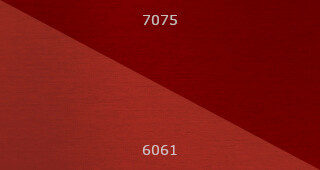
OX-A can be pigmented blue. The shade depends on the treated aluminium alloy. The image shows the indicative color obtainable on alloys 7075 and 6061.

OX-AR - Red Color
OX-A can be pigmented red. The shade depends on the treated aluminium alloy. The image shows the indicative color obtainable on alloys 7075 and 6061.
TECHNICAL SPECIFICATIONS
Composition and applicable standards
| Composition | |||
|---|---|---|---|
| The OX-A treatment transforms the aluminium substrate into a compact layer of aluminium oxide. The coating composition is thus strongly dependent on the starting alloy. | |||
| Al | O | S | Impurities |
| 20÷40% | 50÷70% | 3÷5% | Depending on the alloy |
| Technical standards |
|---|
| ISO 7599 |
| MIL-PRF-8625 Type II |
| RoHS compliance |
|---|
| RoHS compliant. No restricted substances present in amounts greater than the maximum tolerated concentrations. |
| REACH compliance |
|---|
| REACH compliant. No SVHCs present in amounts higher than 0.1% by weight. |
Anodizable alloys
| Wrought alloys | Characteristics | |
|---|---|---|
| Containing high percentages of copper or zinc | Corrosion resistance | ★★★☆☆ |
| Maximum thickness | ★★★★☆ | |
| Other alloys | Corrosion resistance | ★★★★★ |
| Maximum thickness | ★★★★★ | |
| Casting alloys | Characteristics | |
|---|---|---|
| Alloys with Si>8% or Cu>2% | Corrosion resistance | ★☆☆☆☆ |
| Maximum thickness | ★☆☆☆☆ | |
| Die castings with Si<8% or Cu< 2% | Corrosion resistance | ★★☆☆☆ |
| Maximum thickness | ★☆☆☆☆ | |
| Other alloys | Corrosion resistance | ★★★☆☆ |
| Maximum thickness | ★★★☆☆ | |
Treatment thickness and aesthetic appearance
| Coating thickness | |
|---|---|
| Standard thickness | Tolerance |
| 15µm | ±5µm |
30% of the treatment thickness is due to external film growth and 70% is due to film growth in the surface of the aluminium part. The radial dimensional increase can thus be calculated as 30% of the treatment thickness.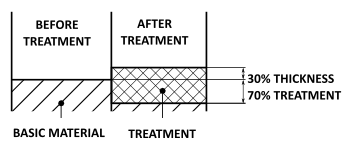 | |
| Uniform thickness over the entire external surface. Reduced thickness in holes. | |
| Aesthetic appearance |
|---|
| Semi-polished appearance with light grey color. The color depends on the base alloy. Reproduces the morphology of the machined part. |
| Option of black coloration in the OX-AN version |
| Available with blue pigmentation in the OX-AB version |
| Available with red pigmentation in the OX-AR version |
Tribological properties
| Wear resistance |
|---|
| Resistance to moderate wear and scratches. To meet higher demands, OX-HS and OX-W treatments can deliver very high wear resistance. |
| Coefficient of friction |
| The OX-A-PTFE variant consists of an impregnation treatment of the anodizing layer with nanometric PTFE particles. This impregnation provides a non-stick, self-lubricating surface with a low coefficient of friction. |
Chemical properties
| Corrosion resistance | ||
|---|---|---|
| The OX-A treatment makes it possible to achieve high corrosion and oxidation resistance. It exceeds the resistance requirements of the accelerated salt spray corrosion test according to MIL-PRF-8625 Type II. | ||
| Corrosion resistance value | Substrate material | |
| NSS to MIL-PRF-8625 3.7.1.2 | ||
| ≥336 hours | 6000 alloy | |
| Chemical resistance | |
|---|---|
| Indicative environmental compatibility values. Actual environmental resistance must still be tested in the field. | |
| Hydrocarbons (e.g. petrol, diesel, mineral oil, toluene) | |
| Alcohols, ketones (e.g. ethanol, methanol, acetone) | |
| Neutral saline solutions (e.g. sodium chloride, magnesium chloride, seawater) | |
| Dilute reducing acids (e.g. citric acid, oxalic acid) | |
| Oxidizing acids (e.g. nitric acid) | |
| Concentrated acids (e.g. sulfuric acid, hydrochloric acid) | |
| Dilute bases (e.g. dilute sodium hydroxide) | |
| Oxidizing bases (e.g. sodium hypochlorite) | |
| Concentrated bases (e.g. concentrated sodium hydroxide) | |
DOWNLOADS
 Technical data sheet
TECHNICAL GUIDE
Complete anodizing technical guide
Technical reference for aluminum anodizing in precision mechanics
- OX coating comparison
- ISO 7599 and MIL-A-8625
- Treatment selection by application
PRODUCTION PLANT

