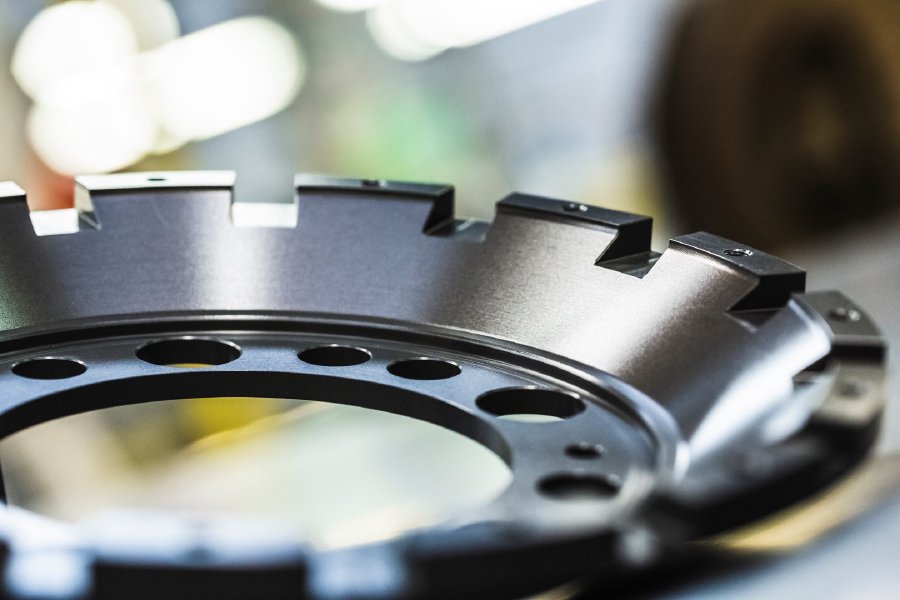
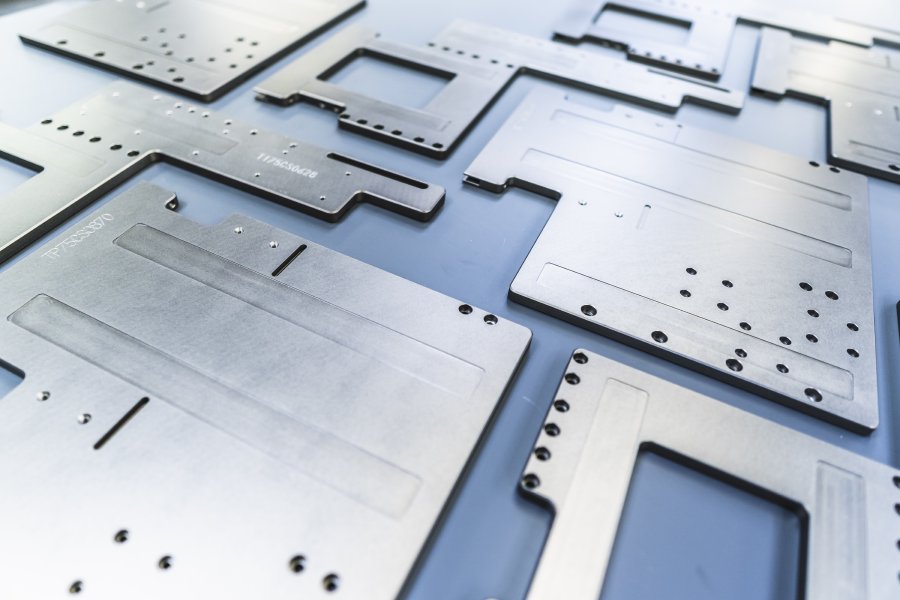
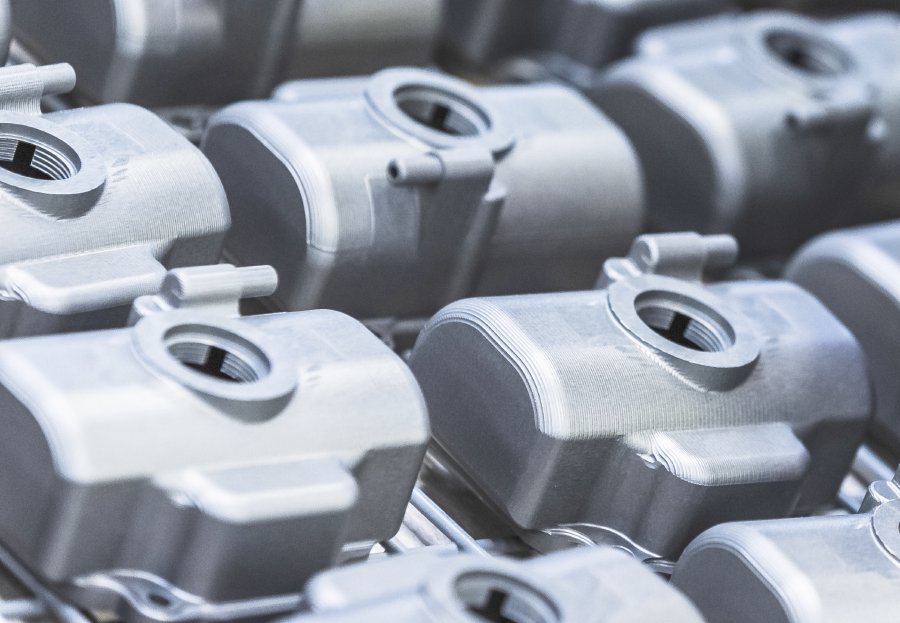
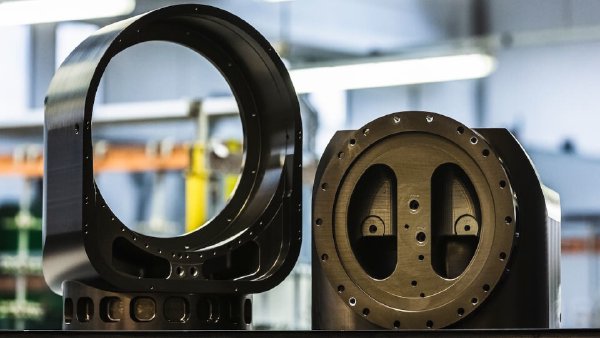
Anodizing, also called anodic oxidation, is a surface treatment of aluminum alloys that creates a protective layer of aluminum oxide on the surface of the part.
Anodizing is performed by means of an electrolytic process in sulfuric acid solutions. Following a preparation cycle, the aluminum parts are dipped into the anodizing electrolyte. The application of direct current causes a process of controlled oxidation of the surface, which forms a compact layer of aluminum oxide.
The main characteristics of anodizing are:
corrosion resistance,
hardness and wear resistance,
uniform thickness,
dielectric insulation,
possibility of coloring with dyes that penetrate into the oxide layer.
The treatment can be divided into two main types: low-thickness clear anodizing and high-thickness hard anodizing.
Hard anodizing imparts properties of very high corrosion resistance and exceptional wear resistance to the treated part. This process is employed to extend the lifetime of mechanical components in various sectors, such as automated machinery, textile machines, automotive, cycles and motorcycles, maritime, and many others.
MICRON COATINGS Group provides aluminum anodizing through Durox srl
, with proprietary OX processes and facilities for large parts as well.
Free resource
Technical Guide to Anodizing
Complete technical reference for aluminum anodizing applied to precision engineering
Wear and corrosion resistance | ISO 10074 | MIL-PRF-8625 Type III
OX-HS is a hard anodizing treatment of aluminium in sulfuric acid in compliance with MIL-PRF-8625 Type III, ISO 10074, and UNI 7796 standards. It imparts excellent corrosion and wear resistance, high hardness and resistance to aggressive environments. The OX-HS treatment can be pigmented in deep black, blue or red. The deep black allows for color uniformity on different aluminium alloys.
VARIANTS
OX-HC - Black Pigmented Hard Anodizing OX-HB - Blue Pigmented Hard Anodizing OX-HR - Red Pigmented Hard Anodizing OX-HS-PTFE - Hard Anodizing with PTFE impregnation
Wear and corrosion resistance | Low surface roughness | Light color | ISO 10074 | MIL-PRF-8625 Type III
OX-W is a special hard anodizing treatment for aluminum in compliance with MIL-PRF-8625 Type III, ISO 10074, and UNI 7796 standards. Compared with conventional hard anodizing, OX-W provides lower surface roughness, higher corrosion resistance and a lighter color. OX-W can be pigmented deep black, blue or red. Deep-black pigmentation provides a uniform color across different aluminum alloys.
VARIANTS
OX-WN - Black Pigmented Hard Anodizing OX-WB - Blue Pigmented Hard Anodizing OX-WR - Red Pigmented Hard Anodizing OX-W-PTFE - Hard Anodizing with PTFE impregnation
Corrosion resistance | ISO 7599 | MIL-PRF-8625 Type II
OX-A is a clear aluminium anodizing treatment in compliance with MIL-PRF-8625 Type II and ISO 7599. It is used to protect aluminium from environmental oxidation because it has a good level of corrosion resistance and appreciable scratch and wear resistance. The OX-A treatment can be pigmented in deep black, blue or red, thus equalizing the color on all aluminium alloys.
VARIANTS
OX-AN - Black Pigmented Clear Anodizing OX-AB - Blue Pigmented Clear Anodizing OX-AR - Red Pigmented Clear Anodizing OX-A-PTFE - Clear Anodizing with PTFE impregnation
The outstanding feature of anodized coatings is their exceptional corrosion resistance.
Corrosion resistance can be improved even further by performing a post-anodization sealing treatment. Sealing is performed in a high temperature solution (approx. 95°C).
Hard anodizing provides the best corrosion resistance for aluminum, which can exceed 1000 hours of neutral salt spray without the onset of corrosion.
The hardness and compactness of the aluminum oxide film makes it possible to achieve high resistance to abrasive and adhesive wear, comparable to that of hard chrome plating.
Hard anodizing, which is frequently applied with thicknesses of 40-60 µm, can produce hardness values higher than 450HV.
The coating hardness depends on the type of aluminum alloy, because the oxide layer is obtained by converting the substrate material.
Anodizing creates a surface layer of aluminum oxide that reproduces the surface morphology of the part. Thanks to this characteristic, different aluminum surface finishes (polished, satin-finished, brushed, shot-blasted, etc.) are retained after anodizing.
The anodizing color changes in accordance with the process type, coating thickness, and the aluminum alloy. It can have a clear, metallic surface appearance with thin coatings or dark grey self-coloration for thick-film hard anodizing.
Anodizable aluminum alloys
Anodizing can be carried out on all aluminum alloys, whether machined from solid stock, extruded, cast, die cast, or forged.
The final coating characteristics vary depending on the alloy used, especially in terms of color, hardness, and corrosion resistance.
Certain alloys, such as those with high silicon content (casting alloys) or high copper content (2000 series), may be difficult to treat. This is why we developed the specific OX-W treatment, which produces improved surface characteristics compared to conventional anodizing treatments.
Wrought alloys
2000 series
5000 series
6000 series
7000 series
Casting alloys
Die casting alloys
Forging alloys
Certifications and reference standards
PRODUCT TECHNICAL STANDARDS
Compliance with ISO 7599 Anodizing of Aluminium - Decorative
Compliance with ISO 10074 Anodizing of Aluminium - Hard Anodic Oxidation
Compliance with MIL-A-8625 Anodic Coatings for Aluminum - Type II, Type III
Compliance with UNI 7796 Anodic oxidation of aluminum
CHEMICAL SAFETY
REACH compliance, compliance with regulations on SVHC (substances of very high concern) content in articles
RoHS compliance, compliance with regulations on contents of metals subject to restriction
FOOD CONTACT
Compliance with EN 14392 Requirements for anodized products for use in contact with foodstuff
Food Contact Materials (FCM) compatibility - Reg. (EC) 1935/2004 Materials and articles intended to come into contact with food
Compliance with GMP - Reg. (EC) 2023/2006 on good manufacturing practice
MANAGEMENT SYSTEMS
ISO 9001 quality management system certification
Compliance with CMRT and CRT, no use of conflict minerals
When discussing aluminum anodizing, one of the most important, and often underestimated, aspects is the sealing phase of the anodic layer.
It is precisely this phase that determines the corrosion resistance, color stability, and treatment durability.
One of the most common questions we receive from those approaching a technical surface treatment for the first time is:
“How much does it cost per kilo?”
Whether we’re talking about electroless nickel plating or anodizing, the correct answer is: it depends.
Clean energy has become a top priority for governments and industries around the world, as reducing greenhouse gas emissions is essential to limiting the impact of climate change. In this context, hydrogen is emerging as a promising clean energy source for vehicles and beyond.
Hard anodizing of aluminum is a process that allows creating a layer of aluminum oxide on the material’s surface with hardness and wear resistance properties superior to those of natural or architectural anodizing.